

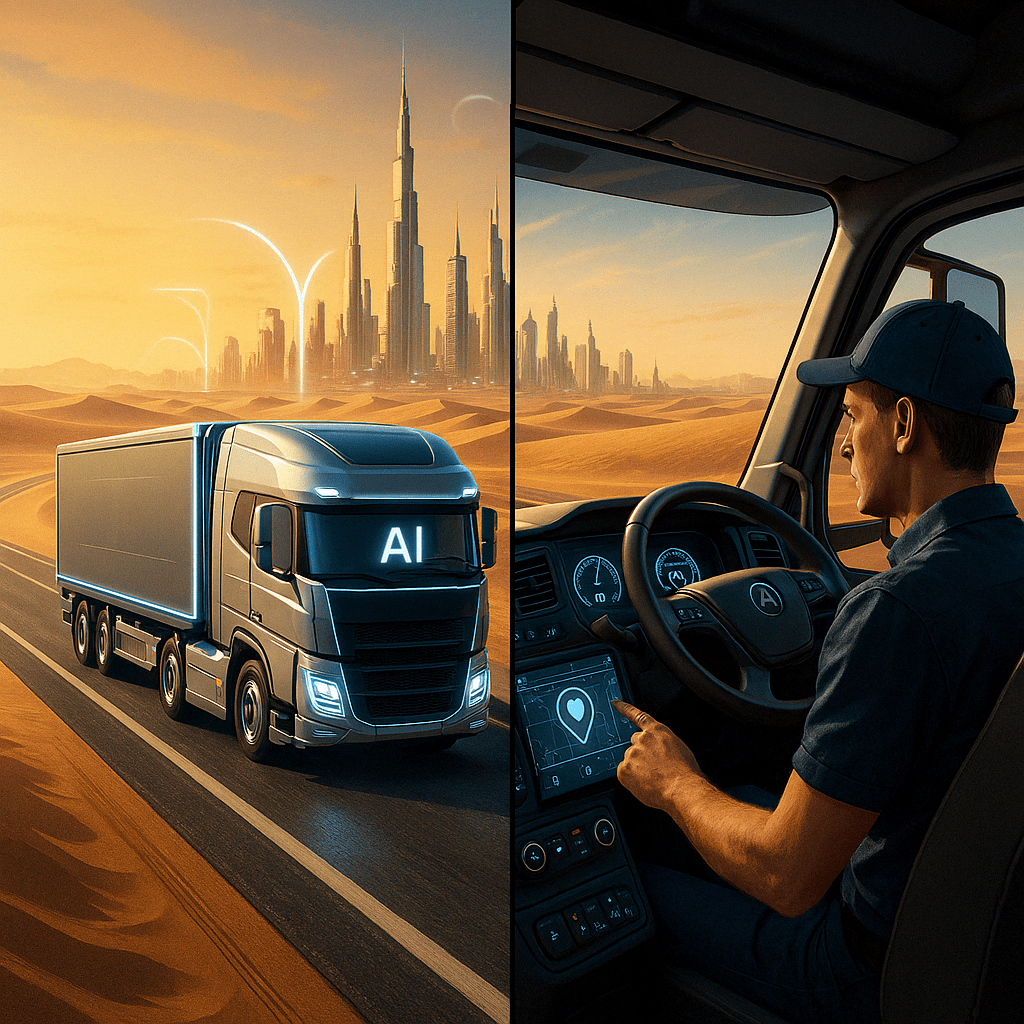
The Real Impact of Automation on GCC Trucking Jobs
As AI continues to evolve, one question echoes across the logistics industry:
“Will AI take over truck driving jobs?”
In the GCC—where trucking is the backbone of trade and infrastructure—this isn’t just a tech debate. It’s a workforce issue, a business strategy, and a regional priority.
🚛 What AI Is Already Doing
AI isn’t the future—it’s the present.
In GCC logistics, we’re already seeing:
- Predictive route optimization
- Advanced driver-assistance systems (ADAS)
- Fleet telematics powered by machine learning
- Semi-autonomous trucks in pilot programs
But here’s the truth: Full replacement of human drivers is still far off—especially given the GCC’s unique roads, regulations, and long-haul patterns.
🧠 Why Human Drivers Still Matter
Even as automation rises, human skills remain irreplaceable:
- Judgment in complex traffic scenarios
- Cultural and cross-border communication
- Maintenance checks, loading supervision, and client interactions
The driver’s role is evolving, not disappearing. Smart logistics companies are already upskilling drivers, turning them into tech-enabled fleet operators.
🌍 The GCC Perspective
Countries like the UAE and Saudi Arabia are embracing automation—but with balance:
- Government visions (like Saudi Vision 2030) prioritize tech and employment.
- Public-private partnerships are investing in smart transport and workforce development.
- AI is an enhancer, not an eliminator.
🚀 What Companies Should Do Now
✔️ Embrace tech tools that support—not replace—your drivers
✔️ Invest in driver training + digital skills
✔️ Talk to your teams: fear of replacement slows adoption
✔️ Be transparent about tech strategy—it builds trust
💬 What’s Your Take?
Do you think AI will replace human drivers in the GCC anytime soon? Or will we always need a human touch on the road?
Drop your thoughts below ⬇️ Let’s start a real conversation about the future of our industry.
 Ardelmuheet
Leave a comment